Summary
Dyson’s innovative vacuum cleaner technology represents a significant advancement in home cleaning by automatically adapting suction power and brush behavior to different floor types for optimized performance. Utilizing powerful digital motors, intelligent sensors, and embedded software, Dyson vacuums dynamically adjust cleaning mechanisms in real-time, ensuring deep and efficient removal of dust, debris, and allergens from a variety of surfaces. This integration of hardware and software enables models such as the Dyson V15 Detect and V16 to provide scientifically validated cleaning results while enhancing user convenience through features like real-time particle counting and laser dust detection.
At the core of this innovation is Dyson’s Hyperdymium digital motor capable of delivering up to 315 air watts of fade-free suction, paired with advanced cleaner heads that modulate brush bar speed and suction based on detected floor types. These cleaner heads incorporate anti-hair wrap designs and adaptive brush technology, allowing vacuums to maintain strong suction and reduce wear on hard floors and carpets alike. Additionally, embedded electronics and sensor arrays—including acoustic piezo sensors and laser systems—collect and analyze data continuously, allowing the vacuum to optimize energy use and cleaning effectiveness autonomously.
Dyson’s technology has also expanded into robotic vacuums, where navigation systems use multiple sensors and real-time mapping to autonomously adapt cleaning strategies across various environments. The Dyson 360 Vis Nav model exemplifies this by combining powerful suction with precise edge detection and obstacle avoidance, further advancing autonomous floor care. These developments have positioned Dyson as a leader in cordless and smart vacuum technology, influencing industry standards and prompting competitors to pursue similar adaptive cleaning features.
Despite widespread praise for its powerful cleaning and intelligent features, Dyson’s adaptive vacuum technology has faced some criticism, particularly regarding performance on certain carpet types where the auto-adjusting heads can cause difficulties with rug movement or require manual intervention. Nonetheless, Dyson’s continuous investment in research and development, including a £1 billion commitment to innovation, underscores its role in driving the evolution of vacuum cleaners toward smarter, more efficient, and environmentally conscious solutions.
Technology Overview
Dyson’s innovative vacuum cleaners incorporate a combination of advanced mechanical design, intelligent electronics, and sophisticated software to deliver unmatched cleaning performance across various floor types. Central to this technology is the use of powerful digital motors, intelligent sensors, and adaptive control systems that optimize suction power and brush behavior in real-time.
Digital Motor and Adaptive Suction
At the heart of Dyson vacuums is the Hyperdymium digital motor, capable of spinning up to 135,000 revolutions per minute (rpm) and generating powerful suction necessary for deep cleaning. This motor delivers up to 315 air watts (AW) of fade-free suction in the latest models, enabling the vacuum to maintain consistent cleaning performance. The motor’s control system intelligently adjusts suction power based on floor type and debris volume, optimizing energy use and cleaning efficiency.
Intelligent Sensor Technology
Dyson vacuums are equipped with an array of sensors that detect floor types, debris levels, and obstacles. Models such as the V15 Detect and the Dyson 360 Vis Nav robot vacuum utilize piezo acoustic sensors that count and categorize dust particles by analyzing vibrations caused by debris entering the vacuum. The sensor data is displayed on an integrated LCD screen, providing users with real-time feedback on cleaning effectiveness and particle size. Additionally, laser technology integrated into cleaner heads reveals hidden dust on hard floors by casting a precise angled beam to enhance contrast between dust and the floor surface.
Adaptive Brush Bar and Cleaner Heads
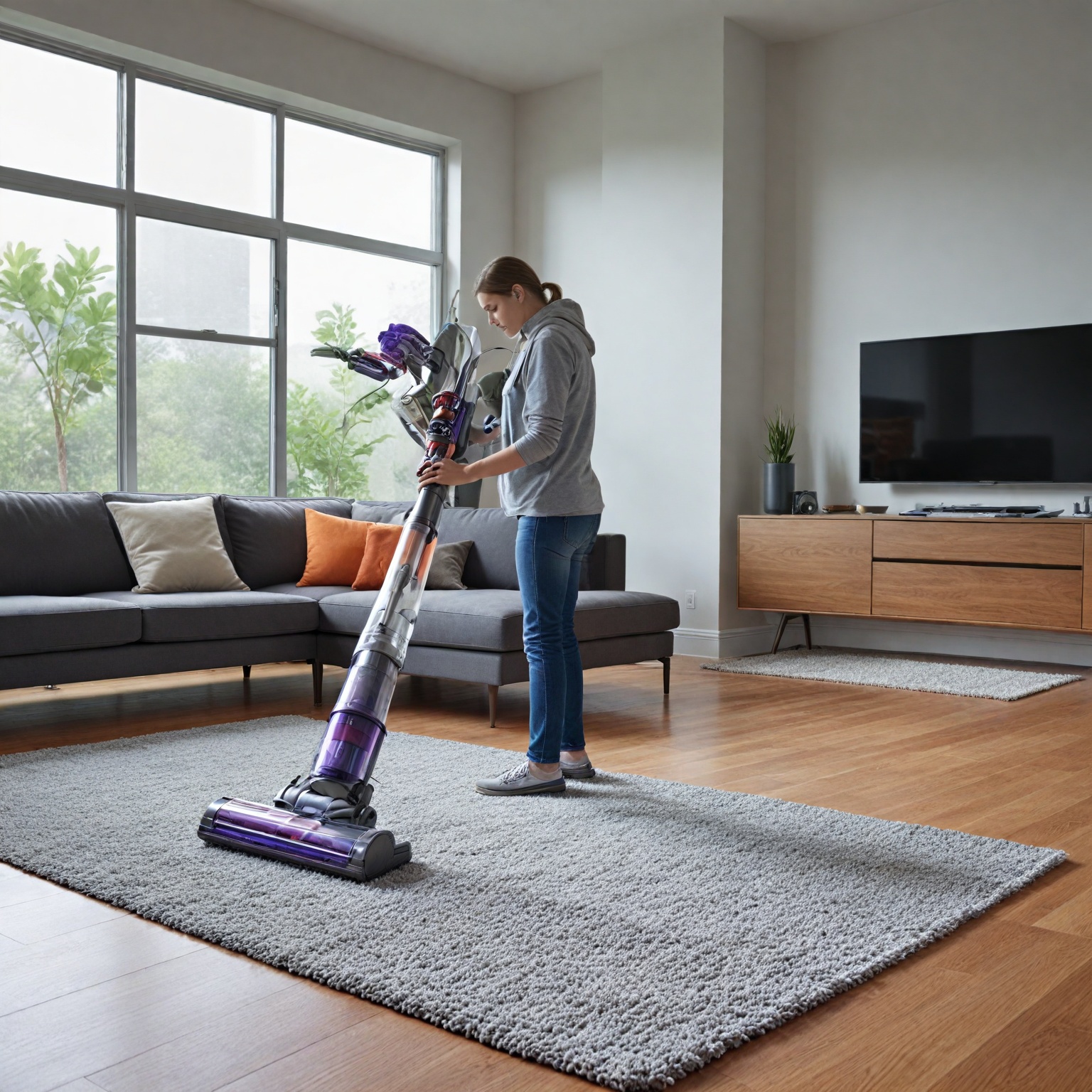
Dyson’s cleaner heads intelligently adjust brush bar rotation speeds and suction power based on detected floor types to optimize cleaning and reduce wear. The All Floor Cones™ Sense cleaner head, featured in the latest models, includes conical brush bars designed to prevent hair tangling by migrating hair toward the suction inlet for direct removal. These brush bars slow down on hard floors for gentle cleaning and lower noise, while increasing speed and agitation on carpets to maximize dirt removal. The Digital Motorbar™ cleaner head further enhances this adaptive behavior by monitoring brush bar resistance 360 times per second and adjusting power accordingly in Auto mode.
Embedded Software and Control Systems
Sophisticated embedded software plays a crucial role in integrating sensor input with motor and brush control, enabling dynamic responses to changing floor conditions. The software algorithms intelligently modulate suction and brush speeds to balance cleaning power with battery efficiency, representing a significant advancement over previous models that primarily adjusted suction alone. This integration allows Dyson vacuums to deliver powerful, uninterrupted cleaning tailored to real-life messes and floor variations.
Navigation and Autonomous Cleaning
In robot vacuum models like the Dyson 360 Vis Nav, navigation is achieved through a combination of 26 sensors, including visual and proximity sensors, that enable precise positioning within 71 millimeters and comprehensive obstacle avoidance. These sensors facilitate 360° navigation and edge detection, allowing the robot to clean effectively along walls and into corners without manual intervention. The system’s high-level processor continuously collects and processes sensor data to adapt cleaning strategies autonomously, making the device highly effective for independent operation.
Together, these technologies form an integrated system that allows Dyson vacuums to automatically adapt their cleaning mechanisms based on floor type, dust presence, and user needs, providing a scientifically validated deep clean with optimal power efficiency and ease of use.
Design and Engineering
Dyson’s latest vacuum designs emphasize intelligent adaptation to various floor types, combining advanced mechanical engineering with sophisticated sensor technology to optimize cleaning performance. Central to this innovation is the control of both suction power and brush bar speed, enabling the vacuum to automatically adjust its cleaning mechanism depending on whether it is operating on hard floors or carpets. Steph Parker, an engineer involved in designing the Dyson V16, explains that this dual control system marks a significant advancement over previous models, which primarily increased suction without dynamically adjusting the brush bar speed to the same extent.
A key feature in Dyson’s engineering is the All Floor Cones™ Sense cleaner head, which incorporates two conical brush bars designed specifically to prevent hair from tangling. The conical shape promotes hair migration from the center to the edges, where it is then directly sucked into the bin, effectively tackling long hair up to 25 inches. This cleaner head not only adapts suction power but also modulates brush bar rotation speeds, slowing down on delicate hard floors to reduce noise and avoid damage while speeding up on carpets for maximum agitation and deep cleaning.
The brush bar itself is engineered with stiff nylon bristles that penetrate deeply into carpet fibers to extract embedded dirt, while a 25cm-wide cleaner head equipped with soft nylon and anti-static carbon fiber filaments excels at removing fine dust from hard floors and tight spaces. This combination ensures edge-to-edge cleaning performance that is both powerful and gentle on different surfaces.
Dyson’s design philosophy also extends to the modularity and versatility of their cleaner heads. Models often include a Motorbar cleaner head optimized for carpets and all surfaces, as well as a Fluffy or Laser Fluffy head specialized for hard floors. These heads, combined with a comprehensive set of tools such as crevice and combination brushes, enable the vacuum to handle a variety of cleaning tasks effectively. The Motorbar head also features anti-hair wrap technology, making it particularly suitable for households with pets.
The integration of sensors further elevates Dyson vacuums by enabling real-time data analysis to adjust suction dynamically. For instance, the V15 Detect model includes a piezo sensor that counts and categorizes dust particles, displaying this information on an LCD screen and automatically modifying suction power based on dust levels. This intelligent feedback loop ensures efficient cleaning while providing users with visible confirmation of the vacuum’s performance.
Behind these hardware innovations is sophisticated electronics and software design. Dyson employs advanced motor control systems and embedded processor technologies to manage multiple drive motors, brush speeds, and wireless communication. Although Dyson vacuums use complex 32-bit microcontrollers, there is evidence that the brushless motor control architecture can be replicated with simpler 8-bit microcontrollers, illustrating the modularity and adaptability of their engineering approach.
Performance
Dyson’s latest vacuum models deliver exceptional cleaning performance through a combination of powerful suction, intelligent adaptation to floor types, and advanced sensor technology. The Dyson V15 Detect, for instance, provides nearly three times the average suction power compared to its competitors, enabling it to pick up more debris with fewer passes. This efficiency is enhanced by the use of two surface-specific cleaner heads: a carpet head that creates a tight seal to extract dirt and dander deep within fibers, and a hard floor head that captures larger messes and highlights fine dust, ensuring no debris is overlooked.
A standout feature across these models is their ability to intelligently adjust suction power based on the type of floor and the volume of dust detected. Using sensors and acoustic piezo technology, the vacuum counts and sizes particles up to 15,000 times per second, displaying real-time dust removal data on an LCD screen. This scientific approach to cleaning allows the vacuum to automatically increase suction when encountering heavier dust concentrations and reduce power to conserve battery when the area is clean. The V15 and V16 models exemplify this capability, adapting suction seamlessly across different floor surfaces without manual input from the user.
The inclusion of versatile cleaner heads has also evolved; while earlier Dyson models used separate attachments for soft floors, the newer V16 features an All Floor Cones Sense floorhead designed to perform effectively on any floor type. This simplification maintains powerful, uninterrupted cleaning performance while reducing the need for multiple accessories. Additionally, Dyson vacuums incorporate brush bars engineered to handle hair tangles automatically, making them especially suitable for homes with pets by removing hair and dander efficiently.
Battery life and motor power contribute further to Dyson’s high-performance cleaning experience. The V15 Detect offers up to 70 minutes of runtime, although high-power “Boost” mode reduces this significantly, requiring users to balance suction strength with battery life depending on cleaning needs. A new motor design delivers fade-free suction of up to 315 air watts, maintaining consistent performance throughout cleaning sessions. The digital displays on these models provide precise run-time countdowns and maintenance alerts, giving users complete control over their cleaning routines.
Despite these advancements, some users have noted challenges, particularly with the auto-adjusting vacuum heads on low-pile carpets and rugs. In some cases, the vacuum’s suction can cause rugs to stick to the floorhead, making movement difficult and requiring manual intervention to adjust brush height or suction power—features currently limited in some models. Nonetheless, Dyson’s integration of smart technology and powerful hardware sets a high standard for cordless vacuum performance, adapting intelligently to real-world cleaning scenarios with minimal user input.
Development History
Dyson’s vacuum technology has evolved significantly through continuous innovation in both hardware and software. A key development in their latest models, such as the V16 and V15 Detect Absolute, is the intelligent control of brush speed and suction power based on the type of flooring. Steph Parker, an engineer involved in the design of the V16, explains that unlike previous models which primarily increased suction, these new vacuums adjust both suction and brush bar speed to optimize cleaning performance on hard floors and carpets.
This advancement is part of Dyson’s broader strategy to enhance cleaning efficiency through intelligent automation. The V15 Detect Absolute exemplifies this approach by incorporating features such as an LCD screen that provides real-time cleaning data, an intelligent suction system that dynamically modulates power, and a laser cleaning head that makes dust visible even on smooth surfaces. These innovations not only improve cleaning effectiveness but also enhance user interaction and awareness of cleaning performance.
Supporting these technological breakthroughs, Dyson has invested heavily in research and development, including the establishment of a new R&D center in the UK focused on electronics design. The company has expanded its software and connectivity teams, now comprising over 55 members, to develop proprietary software for robot vacuum operation and smartphone applications. This commitment is part of a larger £1.5 billion investment announced by Dyson for future technologies, with £1 billion dedicated specifically to new product development. This integrated hardware-software approach has enabled Dyson to push the boundaries of vacuum cleaning technology and maintain its reputation for innovation.
Product Models Featuring the Technology
Dyson incorporates its self-adjusting cleaner head technology across a range of vacuum models to optimize suction power and cleaning performance on multiple floor types. The technology employs an active base plate that automatically adapts to different surfaces, creating a tight seal that prevents air leaks and maintains maximum suction whether on carpets or hard floors.
Among the flagship models utilizing this innovation is the Dyson Ball Multi Floor Upright vacuum. It features a self-adjusting cleaner head that eliminates the need for manual height adjustments, allowing seamless transition between floor types with consistent suction efficiency. The vacuum’s latest ball technology enhances steering and maneuverability around furniture and into tight spaces, making it highly versatile for various home environments.
The Dyson Ball Animal 3 Extra and Ball Animal 3 Complete are designed with households in mind that contend with multiple surface types and the challenges of pet hair and debris. These models combine high-level filtration and auto-adjusting suction with specialized tools like the Pet Groom tool, which directly vacuums loose pet hair from animals to reduce hair spread around the home. Their efficient brush design and multi-mode suction adapt to surfaces ranging from tile to medium-pile rugs and carpeted stairs, making them effective for diverse cleaning tasks.
In addition to upright models, Dyson’s cordless vacuum lines such as the V7, V8, V10 Cyclone, V11, V12, V15 Detect, and V15s Detect Submarine also benefit from versions of this technology, with compatible cleaner heads engineered for deep dirt extraction and surface-specific cleaning. The V15 Detect, for example, stands out for its powerful motor, laser cleaning assistance, and the ability to deliver nearly three times the average suction power compared to competitors, resulting in superior debris pickup on both carpets and hard floors.
Furthermore, Dyson’s most advanced robotic vacuum, the 360 Vis Nav™, integrates sophisticated sensors and navigation systems alongside powerful suction and brush technology that adapt cleaning performance automatically to different floor types. This model boasts six times the suction of other robot vacuums and utilizes a 360° vision system with SLAM mapping to efficiently clean edges and corners across various surfaces.
Market Reception
Dyson’s innovative vacuum models have received widespread acclaim for their powerful cleaning capabilities and intelligent features. The Dyson V15 Detect, in particular, impressed reviewers with its long-lasting battery, powerful motor, and laser cleaning head, which makes invisible dust on hard floors visible to users. This laser feature has been described as a game-changer for cleaning efficiency, especially on laminate floors, while the extended runtime allows for uninterrupted cleaning sessions throughout the day.
Users have praised the technology for its versatility and ease of use across various floor types, with the newer models consolidating multiple floorhead functions into a single, all-purpose design. Unlike previous models such as the Gen5detect and V15 Detect that required separate soft floorheads for delicate hard floors, the V16 uses the All Floor Cones Sense floorhead capable of adapting to any surface. However, some feedback notes limitations in the self-adjusting system’s performance on medium or high-pile carpets and thick padding, making it more suitable for homes with hardwood, tile, or level surfaces.
The vacuums have also gained popularity among pet owners due to specialized features that automatically detangle long hair and pet fur, preventing buildup around the cleaner head. Dyson’s designs address pet-related allergens by capturing microscopic dried skin cells (pet dander) and reducing their spread throughout the home, enhancing indoor air quality and cleanliness.
Consumer enthusiasm is evident in personal testimonials, with users expressing high satisfaction and excitement over the advanced technology and ease of whole-home deep cleaning. One user highlighted the emotional impact of gifting a Dyson vacuum, describing the joy and amazement at the device’s capabilities despite it not being a traditional gift choice.
Technically, Dyson vacuums maintain a competitive edge with superior suction power; for instance, the V15 Detect measured
Competitors and Industry Impact
Dyson’s advancements in vacuum technology, particularly its intelligent suction systems and automation features, have set a high benchmark in the industry, prompting significant competitive responses. The Dyson V16 Piston Animal, the company’s flagship model, exemplifies this with its sophisticated automation mode that intelligently adjusts suction power based on floor type, enhancing cleaning efficiency and user convenience. This level of automation is notably advanced compared to many competitors, pushing the entire cordless vacuum market towards more adaptive and smart cleaning solutions.
However, Dyson is not alone in amplifying automation efforts. Other leading brands, such as Shark, have integrated a variety of detection capabilities into their latest vacuum models, aiming to keep pace with Dyson’s innovations and offer users enhanced cleaning performance through automation. This competitive landscape has driven a broader industry trend where manufacturers focus not only on suction power but also on smart technologies that adapt cleaning based on the environment.
Dyson’s impact extends beyond product innovation into its strategic investment in future technologies. The company has committed to a £1.5 billion investment plan, with £1 billion earmarked specifically for research and development in new product technologies, signaling its ambition to lead ongoing innovation in robotics and smart home appliances. This large-scale investment highlights Dyson’s role as a technological pioneer and influences the direction of vacuum cleaner design and functionality across the market.
Additionally, Dyson’s cordless vacuum technology, combined with a versatile range of tools and accessories, has redefined user expectations for whole-home cleaning solutions. The brand’s continuous innovation has garnered numerous awards in the US market, solidifying its reputation for delivering products that are powerful, easy to use, and highly adaptable to different cleaning needs. This has pressured competitors to elevate their offerings, contributing to rapid advancements in vacuum cleaner performance and automation.
Environmental Considerations
Dyson’s vacuum technology not only focuses on powerful cleaning performance but also addresses environmental factors related to indoor air quality and hygiene. Effective dust removal is crucial because dampening dust—especially the fine, invisible particles—can create a more favorable environment for dust mites and mold proliferation. Research spanning over 30 years emphasizes that the best way to eliminate dust allergens is to remove dust completely, rather than just suppressing it, which underlines the importance of Dyson’s advanced vacuum suction capabilities designed to capture even the finest dust particles invisible to the naked eye.
While mopping can kill germs through the use of disinfectants, it does not physically remove dust particles. Dyson’s approach separates these two tasks, prioritizing suction to remove dust and allergens and reserving mopping for germ elimination. This distinction highlights the environmental health benefits of thorough vacuuming with Dyson devices, which effectively reduce allergens and potential triggers for respiratory issues within the home environment.
Moreover, Dyson vacuums are cordless and powered by rechargeable batteries, which reduce reliance on disposable power sources and contribute to energy efficiency compared to traditional corded vacuum cleaners. The V15 model, for example, boasts up to 70 minutes of battery life under typical usage, making it suitable for extended cleaning sessions without frequent recharging, although higher-power “Boost” modes will decrease runtime.
Additionally, Dyson employs Radial Root Cyclone technology that enhances suction power while maintaining energy efficiency, supporting cleaner indoor environments with less environmental impact. The company also provides a wide range of reusable and durable accessories that fit various cleaning needs, further reducing waste by encouraging long-term use and replacement of parts rather than entire units.
Future Developments
Dyson is preparing to expand its range of floor care products significantly, with several new devices scheduled for release in 2026. This upcoming lineup includes the previously announced PencilVac and three additional related gadgets, alongside a revamped version of the popular V8 cordless vacuum, now reintroduced as the Dyson V8 Cyclone. The updated V8 Cyclone promises a 30 percent increase in suction power, delivering 150 air watts, and doubles the original runtime to one hour from 30 minutes, reflecting a decade of advancement since the original model’s launch in 2016.
Beyond hardware, Dyson is investing heavily in software innovation to enhance its robotic vacuum cleaners. The company has assembled a rapidly growing team of 55 software developers focused on creating proprietary operating systems and smartphone applications that enable seamless control and smarter autonomous cleaning. This effort aligns with Dyson’s broader vision to explore new technological frontiers, supported by a £1.5 billion investment dedicated to future technologies, including £1 billion earmarked for research and development of new product innovations.
The forthcoming robotic vacuums will leverage advanced sensors and embedded software to achieve unprecedented cleaning precision. The Dyson 360 Vis Nav™ robot vacuum exemplifies this approach by using intelligent sensors that detect room edges and redirect suction through a side actuator, overcoming the common challenge of effective edge cleaning. Its high-level processor collects real-time data from 26 specialized sensors that detect dust, avoid obstacles, and accurately map walls, enabling the vacuum to locate itself within 71mm of precision.
In addition to improved autonomy, Dyson continues to refine mechanical components such as the Motorbar cleaner head, which now features anti-hair wrap technology to effectively remove hair from floors and brushes. The inclusion of smart brush technology and Dyson’s DLS™ system allows the vacuum to monitor brush bar resistance 360 times per second, dynamically adjusting suction power across different floor types to optimize cleaning performance. This modular design supports a variety of toolkits tailored for tasks such as pet hair removal and detailed cleaning, enhancing the vacuum’s versatility throughout the home.
Together, these developments signal Dyson’s commitment to delivering intelligent, adaptive cleaning solutions that combine powerful suction, precision navigation, and advanced automation for a superior user experience in the near future.
The content is provided by Avery Redwood, Home Upgrade News