Summary
Unlocking unlimited offline movie watching on Roku devices is made possible and affordable through the use of compatible USB accessories. By connecting an external USB drive to a Roku streaming player or Roku TV, users can store and access a wide variety of movies and media without relying on an internet connection, providing a seamless entertainment experience especially useful during travel or in low-connectivity areas. The Roku Media Player app, either pre-installed or available from the Roku Channel Store, supports multiple popular video formats such as MP4, MKV, MOV, and WEBM, alongside subtitle support for certain file types, enabling flexible and convenient offline playback.
This offline capability is enhanced by the accessory’s compatibility with major smart home protocols like Apple HomeKit, AirPlay, and Matter, allowing integration with broader home automation ecosystems and expanding usability beyond basic media playback. Furthermore, Roku’s platform supports functional extensions through tools like Roku Test Automation (RTA) for developers seeking to automate device testing, and third-party apps like PlayUSB, which offer additional media management features such as playlist creation and subtitle support.
Despite its benefits, offline movie watching on Roku comes with considerations. Users must ensure their USB drives meet power requirements and use compatible file systems like FAT32 or exFAT to avoid detection or playback issues. Additionally, Roku devices do not support DRM-protected content natively, limiting playback of certain purchased or downloaded media, and lower-end or older Roku models may exhibit performance and compatibility limitations that affect user experience. Nonetheless, the affordability of USB accessories and the flexibility they provide make Roku a notable option for offline media consumption in the streaming device market.
Overview
Unlocking unlimited offline movie watching on Roku devices can be achieved affordably with the right accessory. A key consideration is ensuring that the accessory supports major protocols such as HomeKit, AirPlay, or Matter, which enhances compatibility and usability with the Roku platform. By connecting a compatible USB drive, users can store and watch movies offline directly on their Roku TV, providing a seamless entertainment experience without relying on an internet connection.
When selecting a USB drive, it is important to be aware of power requirements; some drives may need an external power adapter because the Roku device or TV might not supply sufficient power through its USB port, which can lead to detection issues. Additionally, purchasing renewed accessories can be a cost-effective option, as Amazon Renewed products come with compatible and fully functional accessories that are equivalent to those originally shipped with the device.
For developers or advanced users interested in automating tests on Roku devices, Roku Test Automation (RTA) provides valuable tools to facilitate functional testing. The core component, OnDeviceComponent, is initialized directly on the device and supports calls to various Roku Brightscript interface functions, improving test automation capabilities. To ensure optimal performance during testing, it is recommended to use high-end Roku hardware such as the Roku Ultra series, which offers fast processors and Ethernet connectivity to enable rapid feedback during functional tests.
Compatibility
The accessory is designed to work seamlessly with Roku devices that support HomeKit, AirPlay, or Matter protocols, ensuring broad integration with popular smart home ecosystems. For optimal automated testing and functional performance, mid-range and higher-end Roku devices are preferred due to their better processing capabilities and fewer GUI rendering issues; low-end or older Roku devices may experience slower performance and inconsistent display rendering, making them more suitable for manual compatibility testing rather than automation.
When it comes to remote control compatibility, the accessory works with any currently available Roku remote, except for the infrared (IR) remotes designed specifically for Roku TVs. This broad remote support facilitates ease of use without the need for specialized controllers.
Additionally, Roku devices like the Roku Express 4K+ are compatible when used with the appropriate adapters, allowing users to access 4K content and take advantage of enhanced media playback capabilities. The inclusion of USB ports on Roku streaming players and TVs further extends compatibility by enabling offline media playback through apps like Roku Media Player. This native app supports video files in MP4, MKV, MOV, and WEBM formats, with subtitle support available for MKV files using SRT or VTT subtitle formats. Users are advised to format USB drives in FAT32 or exFAT file systems for maximum compatibility and ensure their Roku firmware is up to date to avoid playback issues.
For users interested in expanding media format support, third-party apps such as PlayUSB channel offer additional functionality, supporting a wider range of audio, video, and image file types, along with features like playlists, slideshows, and subtitle support. Moreover, tools like Ondesoft iTunes DRM Media Converter can convert DRM-protected iTunes content into Roku-compatible MP4 videos, further enhancing the range of accessible offline media.
Features
The Roku device includes a built-in USB Type-A port that allows users to connect external storage devices such as USB flash drives or external hard disk drives to play stored media content. This functionality is enabled through the Roku Media Player app, which is usually pre-installed but can also be downloaded from the Roku Channel Store if necessary. The media player supports a variety of formats including video files in MP4, MKV, MOV, and WEBM formats, audio, images, and playlists, providing extensive compatibility for different types of media.
Playback controls are conveniently managed with the Roku remote, allowing users to pause, play, and navigate through their media seamlessly. Subtitles are supported exclusively for MKV video files, with subtitle files in SRT or VTT format needing to share the same name as the corresponding video file for proper display. Users can toggle subtitles during playback by pressing the Star button on the remote.
To ensure smooth playback, USB drives must be formatted using compatible file systems such as FAT32 or exFAT, as unsupported formats may prevent the device from recognizing the storage. Additionally, corrupted media files may cause compatibility issues and should be tested on other devices if playback problems arise.
Some Roku models, such as the Streaming Stick and Streaming Stick+, offer 4 GB of internal storage, while higher-end devices like the Roku Ultra include additional features such as 2 GB of RAM, USB connectivity, Bluetooth, Ethernet, and enhanced Dolby Atmos support. These enhancements contribute to better performance and broader media playback capabilities.
Beyond USB playback, the Roku Media Player also supports streaming media from DLNA servers like Plex on the local network, expanding the ways users can access their personal media collections. Third-party channels, such as PlayUSB, further enhance the Roku experience by enabling fast navigation, playlist creation, slideshow modes, subtitle support, and the ability to resume playback from the last position.
Setup and Usage
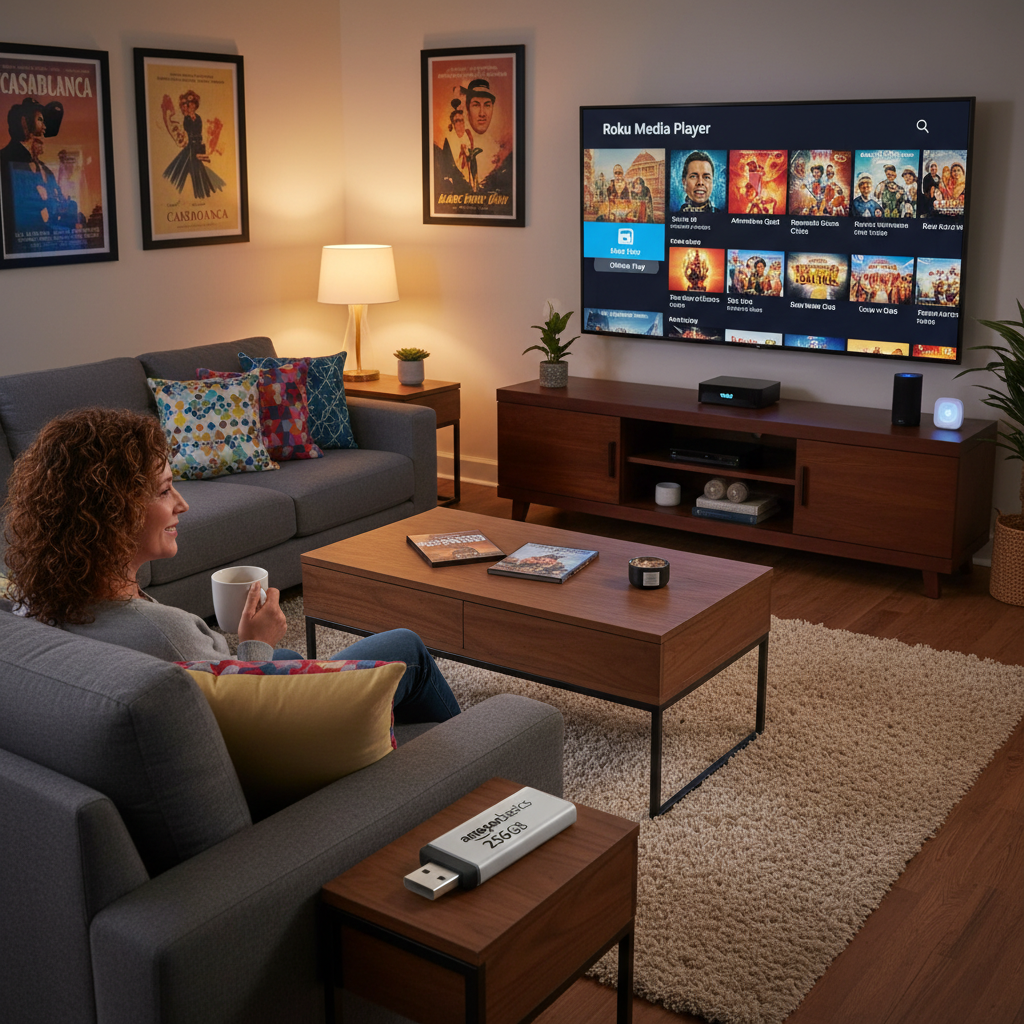
To enable unlimited offline movie watching on your Roku device using a USB accessory, begin by selecting a compatible USB flash drive or external hard drive, such as the Amazon Basics 256GB USB stick. This accessory allows you to store and play movies without requiring an internet connection, making it ideal for offline viewing during travel or in areas with limited connectivity.
Before connecting the USB device to your Roku, ensure it is formatted with a compatible file system, typically FAT32 or exFAT, as Roku devices generally support these formats for USB playback. After formatting, load the USB drive with your movie files—these can be ripped from physical collections or acquired from other sources.
Once prepared, attach the USB device to the built-in USB Type-A port on your Roku streaming device or Roku TV. Upon connection, the Roku Media Player app will typically launch automatically. If it does not, navigate from the Roku Home screen to the Roku Media Player manually by scrolling to the right. This app supports a wide range of media formats, though some file types may not be compatible, so verifying file compatibility beforehand is recommended.
If you have multiple USB drives or require additional storage, you can use a USB hub to connect several devices simultaneously to your Roku. For those experiencing Wi-Fi issues, a USB-to-Ethernet adapter can also be used to establish a wired connection, enhancing network stability during streaming or downloading.
To optimize your offline viewing experience further, users can manage downloaded content within streaming apps on Roku. Certain third-party tools, like StreamFab Roku Channel Downloader, facilitate downloading Roku Channel titles directly to a PC in formats such as MP4 or MKV, enabling ad-free offline playback and batch downloads for full seasons.
By following this setup, users can enjoy a seamless and versatile offline media experience on Roku devices using an affordable USB accessory.
Technical Specifications and Requirements
The Roku platform supports a variety of media formats, enabling users to play videos, music, and photos from USB drives or DLNA servers such as Plex. Supported video formats include H.264/AVC containers like .MKV, .MP4, and .MOV, while audio and image formats cover MP3, FLAC, M4A, AAC, JPG, and PNG among others. Additionally, Roku media players provide features such as subtitle support (closed captions), resume playback, playlist creation, and customizable thumbnails for media organization.
For offline media playback, compatibility with file systems is essential. Roku devices generally support USB drives formatted with FAT32 or exFAT, which ensures proper recognition and playback of stored media files. Users encountering playback issues with certain files are advised to test these files on alternative devices to identify potential corruption or codec incompatibility. Converting files to supported codecs can mitigate many compatibility problems.
Device selection influences performance and automation capabilities. The Roku Ultra series, featuring high-performance processors and Ethernet connectivity, is recommended for test automation and functional duties due to its fast feedback and stability. Mid-range and higher-end Roku devices offer better support for automated testing and debugging tools, whereas lower-end models may present resource limitations.
Regarding video quality, the Roku 4 stands out by delivering 4K video and offering a wider range of 4K-capable apps. However, the supported format range for 4K content remains somewhat limited, which users should consider when selecting media for playback. Firmware updates are essential to maintain compatibility and access improvements in media playback features.
Integration with smart home systems is facilitated by configurable APIs and ports, such as the Roku API accessible on customizable ports (e.g., port 8060), enabling seamless connection with platforms like Home Assistant. Support for technologies like HomeKit, AirPlay, or Matter depends on accessory compatibility.
It is important to note that DRM-protected content, such as movies or TV shows downloaded from the iTunes Store, cannot be played on Roku devices due to licensing restrictions.
Smart Home Integration
The affordable Roku accessory offers seamless integration with popular smart home platforms, enabling enhanced control and automation capabilities. One notable integration is with Home Assistant, a widely used open-source home automation platform. Through the Emulated Roku integration, Home Assistant can emulate a Roku device, allowing remotes such as Harmony and various Android apps to connect via Wi-Fi as if they were interacting with an actual Roku player. This integration exposes an unauthenticated API on the local network, enabling the creation of automations triggered by Roku-like remote commands. Key presses and app launches on the emulated Roku are recognized as events within Home Assistant, which can then be used as triggers to control other devices or execute custom automation scripts.
For example, a user can configure Home Assistant to increase the volume of an amplifier when the “Fwd” key is pressed on the remote by listening for specific roku_command events. This flexibility allows users to extend the functionality of their Roku accessory beyond simple media playback to interact with various smart home devices and services. While multiple Roku servers can be run concurrently to support additional remote buttons, it is important to note that Windows is not supported due to limitations in the underlying network socket implementation.
Additionally, the Roku External Control Protocol (ECP) enables advanced users to discover Roku devices on their network and issue remote commands via HTTP requests. This protocol facilitates network enumeration and remote control scripting, empowering users to create custom automation scenarios or playful interactions, such as remotely controlling friends’ devices. The ECP documentation provides detailed APIs, including device info queries, that can be leveraged to detect device status changes and trigger corresponding events or automations.
Together, these integration capabilities make the Roku accessory a powerful component within a connected smart home ecosystem, allowing both hands-free voice control options and traditional remote interactions to coexist and enhance the user experience.
Benefits
Using an affordable Roku accessory to unlock unlimited offline movie watching offers several significant benefits. One of the primary advantages is the ability to download movies and TV shows directly to the Roku device, enabling users to enjoy their media library without needing a continuous internet connection. This offline viewing capability is especially useful during flights, road trips, or in areas with limited or unstable connectivity, ensuring uninterrupted entertainment on the go.
Moreover, managing downloaded content effectively on Roku allows users to maximize their offline viewing experience by selecting high-resolution downloads for crisp picture quality and prioritizing titles based on storage availability and viewing timelines. Keeping the Roku device updated with the latest software further ensures smooth playback and compatibility with downloaded content, enhancing user satisfaction.
Another notable benefit is the cost savings compared to traditional cable or satellite services, which often charge extra fees for similar features. With this Roku accessory, users can add offline viewing capabilities at no additional cost, requiring just a few simple steps to set up. Additionally, Roku’s compatibility with popular technologies like Apple AirPlay and Matter provides a seamless and user-friendly interface that integrates well with other smart home devices.
For developers and tech enthusiasts, the Roku platform offers opportunities for automation and remote control via External Control Protocol (ECP) commands, enabling customized user experiences and enhanced device management. Although the Roku WebDriver framework lacks built-in screen capture methods, creative workarounds are available for those interested in extending device functionality.
Limitations and Considerations
When using Roku devices for offline movie watching with external accessories, several limitations and considerations should be kept in mind. One major factor is device compatibility and performance, especially on older or low-end Roku models. These devices may exhibit GUI rendering issues that are not detected by automation tools like Roku WebDriver, which only reports element presence in the XML rather than actual screen output. Due to such challenges and the additional resources needed for automation execution and debugging, manual testing is often recommended for compatibility verification on lower-end devices, while mid-range and high-end devices are better suited for automated functional testing.
Another limitation pertains to media format support. Although devices such as the Roku 4 offer extensive 4K video playback and a wide selection of 4K-capable apps, the range of supported media formats remains limited. This can restrict the types of offline videos that can be played natively, necessitating the use of third-party conversion tools like Ondesoft iTunes DRM Media Converter to strip DRM and convert files into Roku-compatible formats such as MP4.
Power supply requirements also influence device compatibility with external USB drives. Some USB hard drives require an external power adapter because the Roku or connected TV cannot provide sufficient power via USB alone. This is a common reason for a Roku device failing to detect a connected USB drive. Furthermore, the file system used by the USB drive must be compatible—formats like FAT32 or exFAT are generally supported, while corrupted files or unsupported file types will not be recognized or played by the Roku Media Player app. Additionally, DRM-protected content is explicitly unsupported by Roku’s native media player.
Storage constraints are another consideration. While many current Roku models, including the latest Ultra, feature 4 GB of internal storage and lack SD card slots, this amount of storage may limit the volume of offline content stored directly on the device.
Finally, for content moderation and community interaction aspects related to Roku usage, platforms like Reddit have encountered challenges in maintaining effective moderation due to API changes, which although unrelated to the technical functionality
Comparison with Other Offline Viewing Solutions
Roku’s offline viewing capability, when paired with an affordable USB stick, offers a distinct approach compared to other streaming devices. Unlike some devices that require built-in storage or cloud-based downloads, Roku allows users to load movies and shows directly onto a USB drive, which can then be plugged into the Roku TV for playback without an internet connection. This method provides flexibility and cost savings since users can repurpose existing USB drives to expand their offline media library.
In contrast, many popular streaming devices rely heavily on their internal storage or subscription-based offline viewing features, which may limit the quantity and type of content available for offline use. For example, devices like the Amazon Fire TV Stick HD, while affordable and highly rated, primarily support offline viewing through specific apps rather than external storage options. Moreover, some streaming devices integrate with smart home ecosystems such as HomeKit, AirPlay, or Matter, offering seamless connectivity but not necessarily enhancing offline media access.
Pricing and Market Availability
Roku streaming devices vary widely in price, with models like the Roku Ultra positioned at a higher price point, which may be beyond the budget of some users seeking offline media playback capabilities. For those looking for more affordable alternatives, Android-based streaming devices such as the Onn Android TV UHD are available at a significantly lower cost, retailing around $20 at major retailers like Walmart.
To enable offline movie watching on Roku devices, an inexpensive USB flash drive accessory is essential. USB sticks, including popular options like the Amazon Basics 256GB drive, are widely available and inexpensive, typically costing between $10 to $15 depending on capacity and brand. These drives can be easily loaded with movies and shows and plugged into the Roku TV’s USB port to facilitate offline viewing without requiring an active internet connection.
Amazon Renewed also offers refurbished Roku products and accessories at reduced prices, providing an affordable option for consumers interested in reliable yet budget-friendly streaming solutions. These renewed products come with compatible accessories and are inspected and tested to ensure full functionality, although some items may not be original.
The content is provided by Sierra Knightley, Home Upgrade News